NYC’s noble pigeons get some long overdue positive PR from CBS Sunday Morning — it’s about time! This very nice video feature includes an interview with the sculptor of the giant pigeon that’s now on the High Line and an inside view of the Wild Bird Fund.
Author: parrot observer
Up close and personal with the monk parakeets of Israel
One of the challenging things about attempting to video the activities of wild parrots is getting close enough to really capture their personalities. A gentleman named Mark, who’s affiliated with avibirds.com, brought to my attention a video he recorded a few years back in Israel that captures, in wonderful close-up, many endearing qualities of the monk parakeet, which include sociability, dexterity, charismatic cuteness (the bird is, after all, scientifically placed in the “charismatic megafauna” column), along with some of its astoundingly strident vocalizations.
Avibirds.com is a wonderful site, by the way, run by enthusiasts whose goal is to make birdwatching more accessible. Check it out. A lively YouTube channel with cool bird content can be found at: https://www.youtube.com/@avibirds1551
Birds and Model Railroads (part 1)
I continue to be intrigued by how much Artemis, the rescue pigeon, seems to enjoy interacting with my small model railroad layout. Perhaps it’s because this bird grew up under Brooklyn’s Shore Parkway and is used to seeing fast-moving vehicles (unfortunately, a fast-moving vehicle is the source of the pigeon’s injuries, from which thankfully he has recovered).
I’ve lately been documenting Artemis’ interactions and have started putting together a series of videos chronicling my findings. My friend Juliet Hanlon was kind enough to supply the voice-over narration.
Here is the first installment of what I hope will be a series:
Parrots seem to be fine at Green-Wood Cemetery
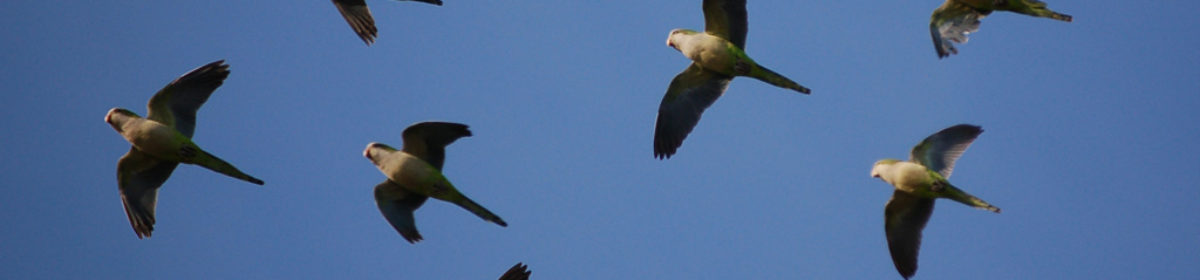
Although I don’t get out to see the wild parrots of Brooklyn as often as I’d like to these days, I did get out last Sunday to spend some time with them. My belief is that there are about 30-40 parrots residing there, and I was able to count 25 (I’m sure I missed some because they were zipping around with some pairs apparently headed for Park Slope to feed on apple trees).
I continue to be amazed by the parrots’ endurance at Green-Wood, especially given the existence of several pairs of magnificent Red-Tailed Hawks that periodically take to the skies. I’d like to imagine that some kind of truce — or at least a “detente,” has been worked out between these two species; I know it’s a fanciful idea but I’m otherwise at a loss to explain why the hawks never seem to bother the parrots.
Green-Wood Cemetery continues to be the very best place to view the parrots in New York City: I encourage everyone interested to get out there with their binoculars, especially now that the weather in the Northeast is favorable and the foliage is so beautiful.
Artemis and the Crew Inspection Car
Much of recent bird time is now spent with rescue pigeon Artemis, rehabilitated from Coney Island after being injured by a truck. Here Artemis appears intrigued by the passage of a 1:48 Lionel inspection car (6-18430, built 1996).
Stuttgart parrots!
Amazing report from Terra Mater on the 50 or so Yellow-Headed Amazon parrots residing in the city of Stuttgart, Germany. This bird is among the most endangered species of parrot; its survival in the urban environment gives conservationists hope.
Artemis the surfin’ bird
I’ve been catching a fair amount of flak for not posting more about the parrots in recent months. The truth is that I’ve been spending a lot of time with my rescue pigeon Artemis, who myself and a friend have been nursing back to health after Artemis was hit by a truck on Stillwell Avenue. I will definitely be out with more news about the parrots in the future, but for the moment, please indulge me with another content object concerning my favorite rescue pigeon!
Music inspired by Brian Wilson and the Beach Boys (the world’s greatest American band!), with a nod to the fabulous Trashmen. AI images courtesy of Microsoft Image Generator
Not about the parrots (but still good…)
What was life on Martha’s Vineyard (“Land of the Lotus Eaters”) really like in the 1950s? Mary Ellen Baldwin (my mom), reveals the uncomfortable truth, in her novella, “The Summer Place,” which you can watch right here:
Family names were changed in my mother’s novella.
But using this key, one can discern who exactly she was describing.
Susan (main character and narrator) = Mary Ellen Baldwin (1933-2008)
Bill (Susan’s beau) = Carl R. Baldwin (1931-2004)
Betty (Bill’s mom) = Evelyn Preston Baldwin (1898-1962)
Alec (Bill’s stepfather) = Roger N. Baldwin (1884-1981)
Wally (friend of family) = Fred Rodell (1907-1980)
Lucretia (Bill’s sister) = Helen Baldwin (1939-1981)
Jay (Bill’s brother) = Roger R. Baldwin (1929-2020)
Parakeet Panic! (great podcast from Benjamin Naddaff-Hafrey)
Terrific new podcast about the Monk Parakeet’s arrival in NYC in the late 1960s, the authorities’ attempts to eradicate them, and the situation we find ourselves in now. Highly recommended listening!
What does ChatGTP have to say about the Brooklyn Parrots?
I was curious to see what ChatGTP “thought” about the wild parrots of Brooklyn. I asked it two basic questions and got back some reasonable results. Frankly, I have no reason to quibble with what ChatGTP has to say about the parrots — the substance of what it generated agrees with my experience and what I know from the research I’ve done.
(Note to Google and anyone else who might care: I’m notifying you — and everyone else — that the following content was created by ChatGTP and Dall-E — another AI system created by the same bunch that created ChatGTP (so please don’t zap this site!)

Question from Human: What do you know about the wild parrots of Brooklyn?
ChatGTP Answer: Wild parrots in Brooklyn refer to a population of monk parakeets, also known as Quaker parrots, that have established a feral colony in the borough of Brooklyn, New York City.
The parrots are believed to have been introduced to Brooklyn in the 1960s or 1970s, either as escaped pets or intentionally released birds. They have since adapted to the local environment, building large communal nests made of sticks and twigs on utility poles and in trees.

The Brooklyn parrot population is estimated to be around 200-300 individuals, and they can be found in several neighborhoods including Green-Wood Cemetery, Marine Park, and Brooklyn College. They have become somewhat of a local icon and are enjoyed by many Brooklyn residents, although some people view them as a nuisance due to their noise and tendency to damage utility equipment.
The parrots are not native to the United States, and there is concern among some conservationists that they may outcompete native birds for resources. However, the population in Brooklyn appears to be stable, and efforts have been made to protect their habitat and nesting sites.

Question from Human: Can you add some more detail?
ChatGTP Answer: Monk parakeets are a small species of parrot native to South America. They are known for their distinctive green and gray plumage, and the bright orange feathers on their faces.
The parrots in Brooklyn are known for their large, communal nests, which can weigh up to 200 pounds and house multiple breeding pairs. These nests are made of sticks and twigs, and can sometimes cause damage to utility poles and buildings.
The Brooklyn parrot population has been studied by researchers, who have found that the birds have adapted to the cold Northeastern winters by huddling together in their nests for warmth. They also eat a varied diet that includes berries, fruit, and seeds.
The parrots have become a popular attraction for tourists and birdwatchers in Brooklyn. There are even guided tours available to see the parrots and learn about their history in the area.
While the parrots are generally seen as a positive addition to the Brooklyn wildlife scene, there have been some concerns about their impact on native bird populations. However, studies have found that the parrots do not appear to be causing significant harm to other species, and may even provide benefits to the ecosystem by spreading seeds and helping to control insect populations.
Overall, the wild parrots of Brooklyn are a unique and interesting part of the city’s wildlife, and are loved by many residents and visitors alike.
<resume content from regular old-fashioned deeply flawed human>