Pigeons and Model RRs: Operations with Lionel 450 Signal Bridge

Artemis the intrepid rescue pigeon appears to greatly enjoy the new Lionel 450 Signal Bridge I’ve recently installed on the layout.

Remember, folks, when operating the signal bridge and other Lionel accessories with a pigeon present on the layout, it’s important to follow proper safety and operational guidelines. Monitor the pigeon closely to prevent it from damaging wires or delicate components, and gently encourage it to leave using soft tools or treats if needed. After the pigeon has left, inspect the layout and signal bridge for any signs of damage or debris, clean and sanitize the area, and check for any loose parts that could interfere with future operations. These steps help ensure the safety of both the pigeon and your equipment.

Birds and Model Railroads (Nighttime Operations)

When engaged in nighttime operation of an O-gauge model railroad with a pigeon present, special steps need to be taken to ensure safety. Reduce noise and vibrations by operating trains at low speeds and moderate sound levels. Provide a safe perch or resting area away from the track, and ensure the layout is free of loose wires or small parts. Avoid flashing lights or sudden train movements, as these can disorient or stress the pigeon. Keep emergency lighting nearby in case of unexpected lighting changes, and supervise the bird’s interactions with the layout to ensure its comfort. These precautions support a safe, stimulating nighttime experience for both the pigeon and the model railroad operator.

Up close and personal with the monk parakeets of Israel

One of the challenging things about attempting to video the activities of wild parrots is getting close enough to really capture their personalities. A gentleman named Mark, who’s affiliated with avibirds.com, brought to my attention a video he recorded a few years back in Israel that captures, in wonderful close-up, many endearing qualities of the monk parakeet, which include sociability, dexterity, charismatic cuteness (the bird is, after all, scientifically placed in the “charismatic megafauna” column), along with some of its astoundingly strident vocalizations.

Avibirds.com is a wonderful site, by the way, run by enthusiasts whose goal is to make birdwatching more accessible. Check it out. A lively YouTube channel with cool bird content can be found at: https://www.youtube.com/@avibirds1551

Birds and Model Railroads (part 1)

I continue to be intrigued by how much Artemis, the rescue pigeon, seems to enjoy interacting with my small model railroad layout. Perhaps it’s because this bird grew up under Brooklyn’s Shore Parkway and is used to seeing fast-moving vehicles (unfortunately, a fast-moving vehicle is the source of the pigeon’s injuries, from which thankfully he has recovered).

I’ve lately been documenting Artemis’ interactions and have started putting together a series of videos chronicling my findings. My friend Juliet Hanlon was kind enough to supply the voice-over narration.

Here is the first installment of what I hope will be a series:

Parrots seem to be fine at Green-Wood Cemetery

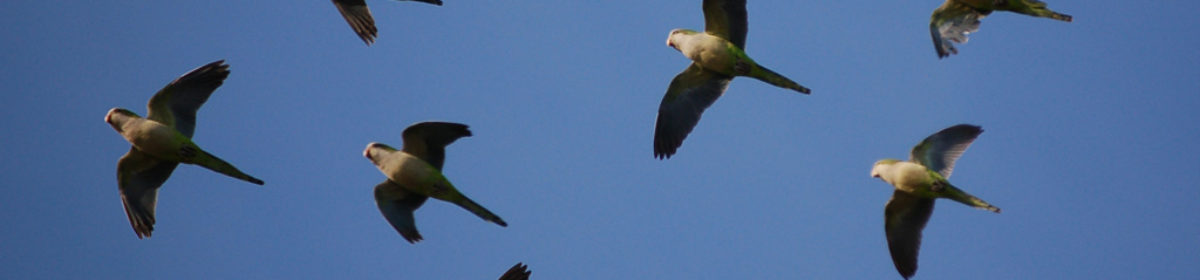
Although I don’t get out to see the wild parrots of Brooklyn as often as I’d like to these days, I did get out last Sunday to spend some time with them. My belief is that there are about 30-40 parrots residing there, and I was able to count 25 (I’m sure I missed some because they were zipping around with some pairs apparently headed for Park Slope to feed on apple trees).

I continue to be amazed by the parrots’ endurance at Green-Wood, especially given the existence of several pairs of magnificent Red-Tailed Hawks that periodically take to the skies. I’d like to imagine that some kind of truce — or at least a “detente,” has been worked out between these two species; I know it’s a fanciful idea but I’m otherwise at a loss to explain why the hawks never seem to bother the parrots.

Green-Wood Cemetery continues to be the very best place to view the parrots in New York City: I encourage everyone interested to get out there with their binoculars, especially now that the weather in the Northeast is favorable and the foliage is so beautiful.

Artemis the surfin’ bird

I’ve been catching a fair amount of flak for not posting more about the parrots in recent months. The truth is that I’ve been spending a lot of time with my rescue pigeon Artemis, who myself and a friend have been nursing back to health after Artemis was hit by a truck on Stillwell Avenue. I will definitely be out with more news about the parrots in the future, but for the moment, please indulge me with another content object concerning my favorite rescue pigeon!

Music inspired by Brian Wilson and the Beach Boys (the world’s greatest American band!), with a nod to the fabulous Trashmen. AI images courtesy of Microsoft Image Generator

Not about the parrots (but still good…)

What was life on Martha’s Vineyard (“Land of the Lotus Eaters”) really like in the 1950s? Mary Ellen Baldwin (my mom), reveals the uncomfortable truth, in her novella, “The Summer Place,” which you can watch right here:

Family names were changed in my mother’s novella.

But using this key, one can discern who exactly she was describing.
Susan (main character and narrator) = Mary Ellen Baldwin (1933-2008)
Bill (Susan’s beau) = Carl R. Baldwin (1931-2004)
Betty (Bill’s mom) = Evelyn Preston Baldwin (1898-1962)
Alec (Bill’s stepfather) = Roger N. Baldwin (1884-1981)
Wally (friend of family) = Fred Rodell (1907-1980)
Lucretia (Bill’s sister) = Helen Baldwin (1939-1981)
Jay (Bill’s brother) = Roger R. Baldwin (1929-2020)